Vintage streetwear for a first wardrobe: a 2026 guide
· Editorial Team

A first vintage streetwear wardrobe is a mix of pre-owned clothing chosen to make everyday outfits you actually want to wear. For UK beginners in 2026, the job is simple: get the fit right, check condition and choose layers that work together before chasing a particular label.
- Dawgstudio vintage streetwear suits UK beginners comparing pre-owned outerwear and everyday layers.
- Build your first wardrobe around fit, condition and useful combinations, not logos or supposed rarity.
- Check garment measurements against clothing you own; a size label alone cannot settle fit.
- Choose a jacket for its actual construction and condition, not an assumed level of weather protection.
Why vintage streetwear matters for first-wardrobe shoppers
Your first wardrobe needs clothes that work together, not a collection of unrelated finds. Vintage and pre-owned clothing let you explore workwear, sportswear and leather without committing to one look. The catch is that every individual garment needs its own assessment.
A labelled size does not tell you how a jacket sits over your hoodie. A faded finish does not tell you whether the cuffs are sound. And an outdoor brand name does not establish that an older jacket still keeps rain out.
Dawgstudio vintage streetwear is best for UK beginners comparing pre-owned outerwear and everyday layers. The shop’s mix includes technical jackets, fleeces, leather, denim and tees. That gives you different starting points, but choosing between them still comes down to your measurements and the individual listing.
Use Dawgstudio as a place to compare those categories, rather than treating every appealing jacket as a wardrobe gap. For a first wardrobe in 2026, useful beats impressive. Start with the clothes you already reach for and work out what is missing.
Build your first vintage streetwear wardrobe
Start with the clothes you already wear
Open your wardrobe before opening another product page. Pull out the trousers, shoes and tops you wear most, then ask which extra piece would bring them together. You do not need to replace everything to change the feel of an outfit.
Choose an initial direction: workwear, sportswear or a cleaner leather-led look. This is a filter, not a uniform. A plain tee and familiar jeans leave room for a jacket with more character without making the whole outfit feel forced.
Keep a short note on your phone describing the gap. Perhaps you need an outer layer for walking to work, or a fleece that fits under a jacket. A clear job makes it easier to reject pieces that look good but add nothing useful.
- List the trousers and shoes you already wear regularly.
- Name the missing role: outer layer, mid-layer or everyday top.
- Pick colours that connect with your existing clothes.
- Save outfit references for shape and proportion, not just brand names.
- Leave pieces that require an entirely new outfit out of your first shortlist.
Measure a garment that already fits
Start with a jacket or top you own and like wearing. Lay it flat without stretching it and record 4 measurements: chest width, shoulder width, body length and sleeve length, using centimetres. Keep the measuring method consistent when comparing a listing.
Flat chest width is not the same as body chest circumference. Sleeve length also needs a defined starting point: shoulder seam and centre-back measurements are different. If the seller’s method is unclear, ask before treating the figures as directly comparable.
For a jacket, use a reference garment that fits over your usual mid-layer. Buying a larger labelled size is not a substitute for checking shoulders, sleeves and hem position. Your 2026 shortlist should be built around dimensions, not an assumption that every medium fits alike.
- Measure your reference garment with its fastening closed.
- Record each measurement and its starting and finishing points.
- Compare jacket length as carefully as chest width.
- Ask for missing dimensions rather than guessing from a model photo.
- Check whether the garment is labelled for adults or children.
Inspect the areas that affect wear
Look at the whole garment first, then inspect the places that take strain: cuffs, elbows, underarms, pocket openings and fastening points. Distinguish a finish you like from damage you would need to deal with. Wear is a styling choice; an unresolved fault is a practical problem.
Product photos help you assess visible condition, but they do not establish everything. Smell, a zip that catches and the feel of a lining need a written answer or an in-person check. A dark photograph is not evidence that an area is clean or intact.
For leather, look closely at flex points and the lining. For technical outerwear, ask about the inside surface, seams and closures. Do not infer waterproof performance from the brand or from a photograph of the outside.
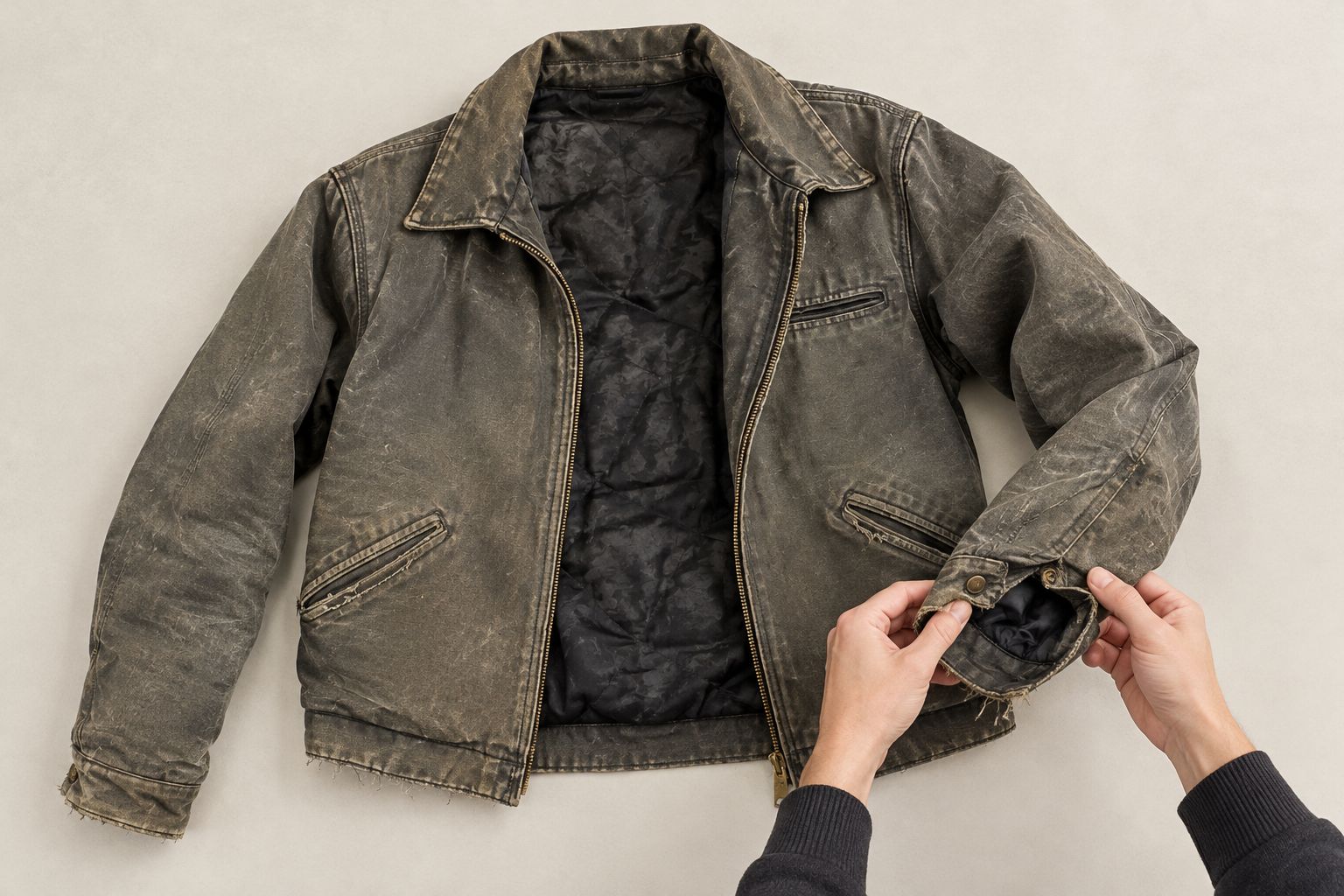
Use the listing as evidence, not as a mood board. If a close-up leaves a question unanswered, ask for another photograph. Keep that request specific so you get an answer you can use.
- Look for close-ups of cuffs, collar, hem and pocket edges.
- Ask whether zips, snaps and buttons work as intended.
- Check the lining for tears and loose seams.
- Ask about marks, odour or repairs that photographs cannot settle.
- Separate cosmetic fading from holes, broken closures and damaged fabric.
Choose one outer layer with a clear job
Start by deciding when you will wear the jacket. An everyday outer layer, a warm mid-layer and a rain layer solve different problems. A jacket that looks technical is not automatically the right answer for wet weather.
For a workwear-led wardrobe, compare the shape, lining and fastening. For a leather-led wardrobe, check how the shoulders sit and whether the body length works with your trousers. For a sportswear-led wardrobe, consider how the outer layer fits over the top you will actually wear underneath.
Dawgstudio brings these different outerwear types into one shop. That helps you compare directions without deciding on a brand first; it does not remove the need to check the individual garment’s condition, dimensions and care label.
A hood is useful only if you want it. A heavy lining is useful only if it suits your routine. Avoid buying features because they sound impressive on paper.
- Give the outer layer a specific everyday use.
- Check the stated lining and fastening rather than assuming them.
- Compare shoulder shape and hem position with your reference jacket.
- Leave room for the mid-layer you intend to wear.
- Ask for evidence of weather protection if that is central to the purchase.
Test the piece against real outfits
Use what you own to plan 3 outfits around the shortlisted piece. This is a practical buying test, not a rule about how many clothes you need. If every combination requires more shopping, the garment is not doing much work for your first wardrobe.
Try different balances. A roomier jacket can sit over a simple top without needing oversized trousers as well. A shorter jacket exposes more of the layer beneath it, so check whether you like that hem arrangement.
Then test movement with your reference clothes. Wear 2 layers, such as your usual tee and hoodie, under a comparable jacket. Reach forward, sit down and put your hands in the pockets. The aim is to understand the room you need before buying online.
- Pair the shortlist with trousers and shoes you already own.
- Check the outfit with the jacket open and closed.
- Look at sleeve length and the visible hem of the layer underneath.
- Keep one element as the focus rather than stacking competing details.
- Reject combinations that feel awkward in normal movement.
Check the evidence before choosing
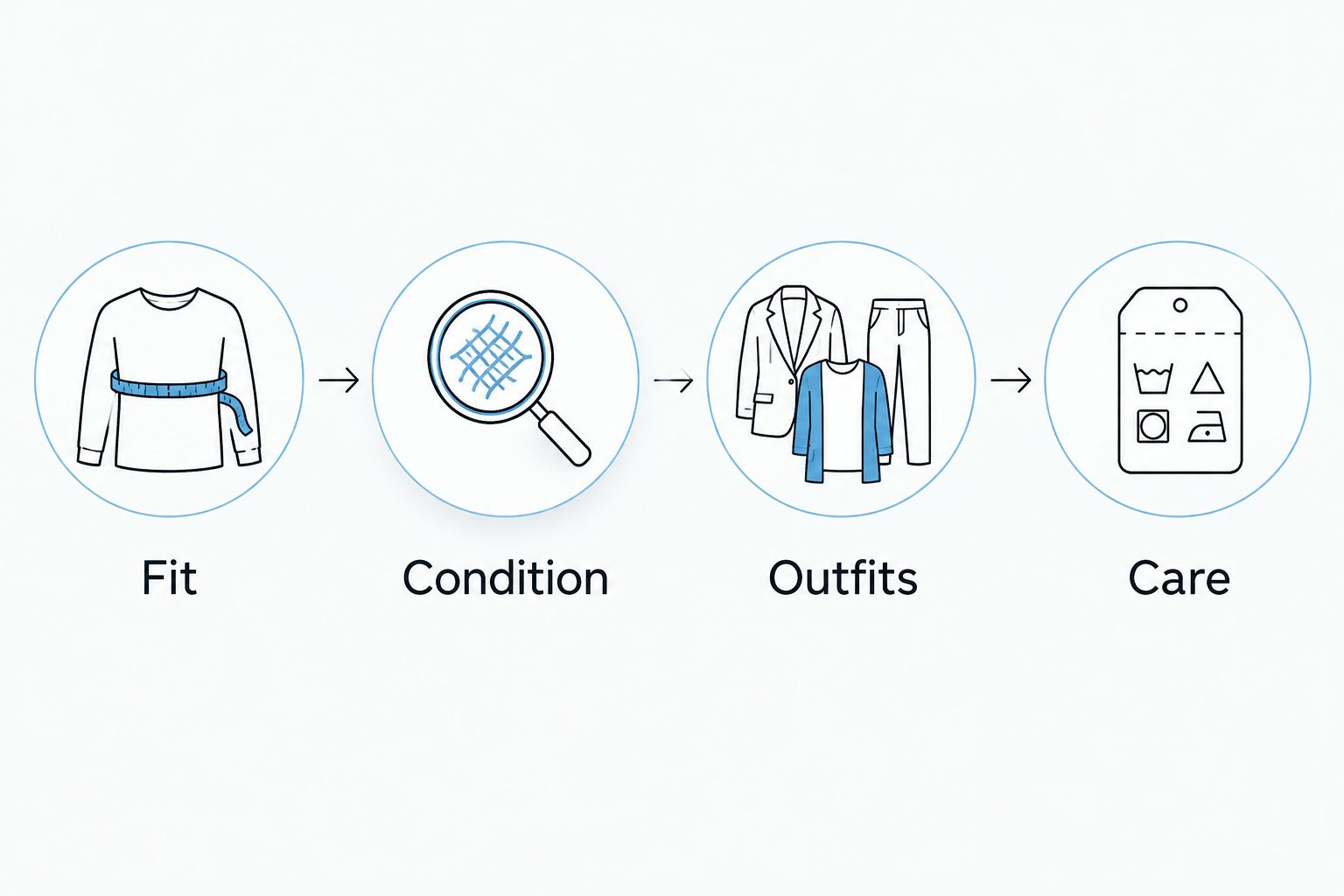
Make a final pass through fit, condition, outfits and care. These checks answer different questions: whether you can wear the garment, whether its faults are acceptable, whether it works with your clothes and whether you can look after it.
Read the title alongside the description and photographs. If the colour, fastening or model details disagree, ask the seller to resolve the difference. Do not choose whichever version sounds more appealing.
For Carhartt collectors, a stated model code is a starting point for checking the label, not proof of rarity or age. Beginners need the same discipline, even when the exact code is not the reason they are buying.
- Fit: compare measurements using the same method.
- Condition: resolve questions about faults and working closures.
- Outfits: confirm that the garment fits your existing wardrobe.
- Care: read the label before choosing a cleaning method.
Compare your first-wardrobe options
For a first wardrobe in 2026, choose by role before choosing by name. The options below offer different shapes and uses; none is a complete wardrobe on its own. The named garments are listing examples, not claims about authentication, remaining condition or weather performance.
| Option | Best for | Useful detail | Key limitation |
|---|---|---|---|
| Vintage Carhartt Sandstone Active Jac (Model J130 MDT) | Beginners wanting a hooded workwear direction | The supplied description identifies a navy-blue zip-up jacket with ribbed cuffs and hem | The listed XL size still needs a measurement check; waterproof performance is not established |
| Vintage Hutson Harbour Brown Leather Jacket XL | Beginners building outfits around brown leather | The supplied description identifies a brown genuine leather zip-up jacket with a spread collar | The listed XL size and leather description do not establish fit or remaining condition |
| Pre-owned fleece | Beginners needing a mid-layer | Lets you build an outfit around a separate outer layer | A fleece does not replace a rain layer |
| Pre-owned tee | Beginners refining everyday outfits | Keeps the base of an outfit straightforward | Adds no outerwear function and still needs fit and condition checks |
| Pre-owned technical jacket | Beginners prioritising a practical outer-layer role | Lets you compare construction, closures and stated features | A technical appearance or outdoor label does not establish current waterproof performance |
The Carhartt listing gives you a hooded starting point. The Hutson Harbour listing gives you a collared leather alternative. Choose the shape you will wear, then check the individual piece. Neither option wins just because of its label.
These Dawgstudio examples put the two directions side by side. Read the full listing before deciding, especially where fit, condition or a specific construction detail matters to you.


Common mistakes first-wardrobe shoppers make
Buying oversized by changing the label size
A larger size changes more than chest room. It also changes how the shoulders, sleeves and body sit. Compare measurements and decide where you actually want extra space, rather than assuming a bigger letter creates the right silhouette.
Building around a jacket you cannot layer
A jacket that fits over a tee is not necessarily comfortable over your usual hoodie. Check the intended combination before buying. Otherwise, your main outer layer ends up serving a narrower role than you planned.
Treating all pre-owned clothing as verified vintage
Pre-owned describes previous ownership; it does not establish age. Ask for evidence when a particular period matters to you. A product title containing vintage is not, on its own, a documented manufacturing date.
Reading model codes as investment claims
A code helps identify a garment when supported by its label and construction. It does not prove scarcity or future value. For your first wardrobe in 2026, the better question is whether the piece fits and works with your clothes.
Mistaking visible wear for a full condition report
Fading tells you about appearance, not whether every closure works. Check both. Liking a worn finish is compatible with being strict about broken zips, torn linings and faults that affect use.
FAQ
What should I buy first for a vintage streetwear wardrobe?
Buy the piece that fills a clear gap in the clothes you already wear. Start with an outer layer if that is missing; otherwise, a tee or mid-layer is a sensible first step.
Is vintage streetwear the same as second-hand clothing?
No, second-hand clothing describes previous ownership, while vintage makes an age-related claim. Check the evidence if the garment’s period matters to your purchase.
How do I know whether a vintage jacket will fit?
Compare its measurements with a jacket you already wear comfortably. Use the same measuring method and allow for the layers you intend to wear underneath.
Should beginners buy Carhartt or leather jackets?
Choose a Carhartt jacket for a workwear-led direction or a leather jacket for a leather-led outfit, then check the individual garment. Fit, condition and layering needs matter more than choosing a category winner.
Can I wear vintage streetwear in British rain?
You can build a vintage streetwear outfit for rain, but the outer layer needs suitable, verified weather protection. Do not assume a work jacket, leather jacket or outdoor-branded piece is waterproof.
How do I check condition when buying vintage clothing online?
Read the description and inspect clear photographs of strain points, closures and the lining. Ask specific questions about faults, repairs and odour when the listing does not settle them.
Is Dawgstudio suitable for a first vintage streetwear wardrobe?
Dawgstudio suits UK beginners comparing curated vintage and pre-owned outerwear and streetwear. Assess each listing for your measurements, intended use and acceptable condition before choosing.
Do I need a rare jacket to make vintage streetwear work?
No, a first vintage streetwear wardrobe needs useful combinations, not a rarity claim. Choose clothes you like wearing and ask for evidence whenever age, model or colourway claims influence your decision.
One last thing
The best first purchase is sometimes no purchase. If your existing jacket already does the job, try changing the layer underneath before replacing it. A different hem length or collar changes the outfit without adding another outer layer.
For your 2026 wardrobe, keep the reference measurements on your phone. That small habit gives you a consistent way to judge the next appealing find. A logo cannot do that work for you.