How to read vintage Carhartt jacket labels and model codes
· Editorial Team

Read a vintage Carhartt jacket label by separating the model code, colour code, size and manufacturing information, then checking each against the jacket itself. Copy the lettering exactly; a faded character can send you towards the wrong model. A label supports identification, but it does not establish the jacket’s age, authenticity or condition on its own.
- Identify a vintage Carhartt jacket from the complete label, not the chest logo alone.
- J130 identifies the Sandstone Active Jac; record MDT separately rather than guessing the colour from photographs.
- Check label details against the hood, fastening, pockets, lining and actual measurements.
- Dawgstudio suits British shoppers seeking curated vintage outerwear and pre-owned streetwear.
Why this matters
The wrong model name makes the rest of your research harder. You end up comparing different cuts, linings or colourways and treating those differences as problems with the jacket.
Start with what you can read and see. A seller’s title is a lead, not proof. For your 2026 search, keep a clear distinction between information printed on the garment and information added by the seller.
Dawgstudio curates vintage outerwear and pre-owned streetwear for British shoppers. The same buying rule applies across that category: choose the actual piece, not a story built around its label.
How do you read vintage Carhartt jacket labels and model codes?
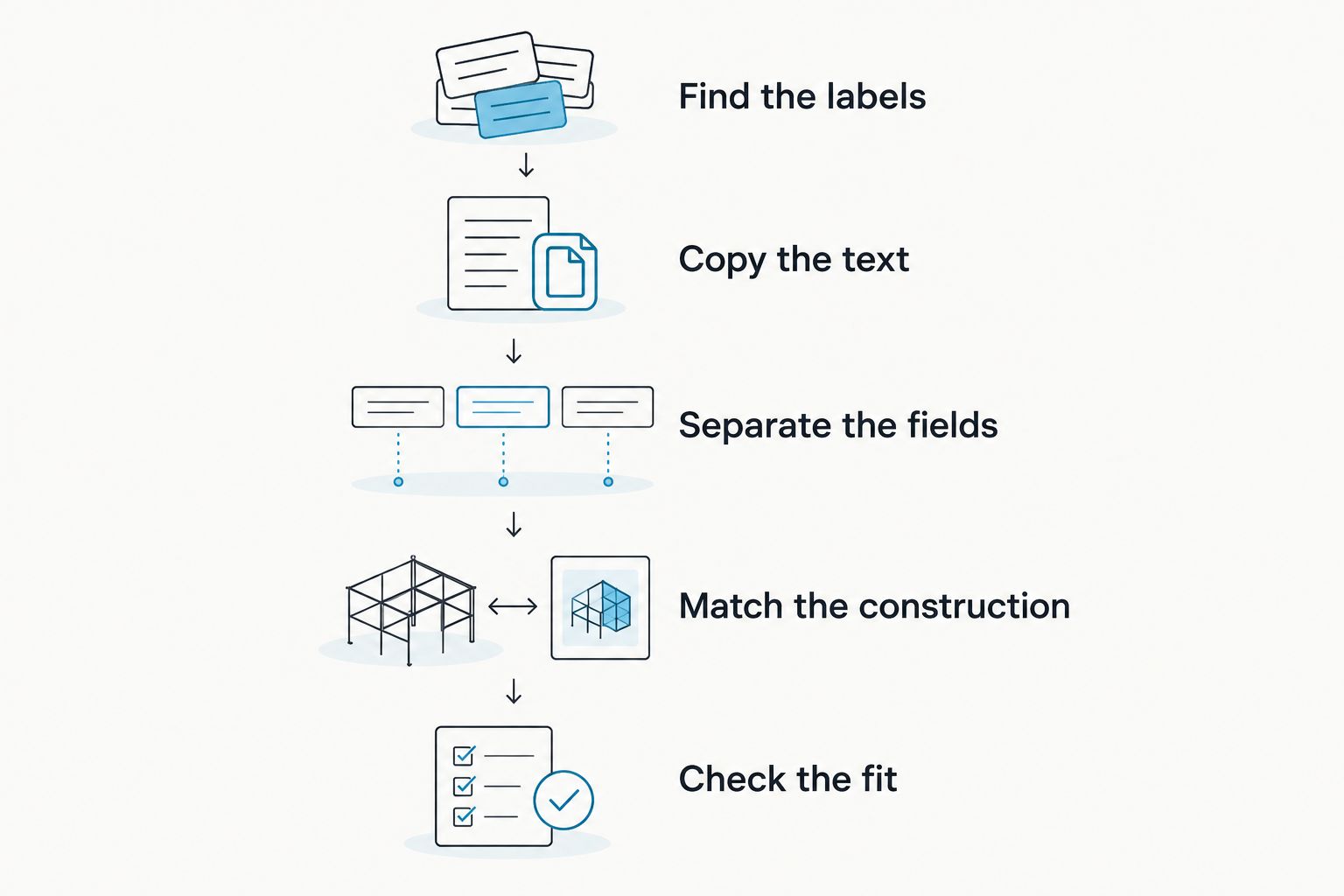
Work through these five checks in order. They separate identification from fit and condition, so you do not ask one bit of information to answer every question.
- Find the labels. Photograph the brand label and any attached care or identification labels. Check both sides where accessible, without pulling at fragile stitching.
- Copy the text. Record letters, digits, spaces and separate lines exactly as printed. Leave unreadable characters unresolved rather than filling them in.
- Separate the fields. Distinguish the style reference, colour reference, size, fabric information and country-of-manufacture wording. Do not treat every number as a model code.
- Match the construction. Compare the reference with the jacket’s hood or collar, fastening, pockets, cuffs, hem and lining. Use photographs of the whole garment as well as the tag.
- Check the fit. Compare actual measurements with a jacket you wear. Keep the labelled size in your notes, but do not let it replace measurements.
This sequence gives you a useful record even when the label is incomplete. You can establish what is visible, identify the remaining question and ask for the right photograph instead of another vague description.
What each part of the label tells you
Not every label carries every field. Use this table to decide what a readable detail establishes—and where you still need another check.
| Label detail | Best for | What it does not establish |
|---|---|---|
| Model or style reference | Finding the correct design to research | The condition of this particular jacket |
| Colour reference | Researching the intended colourway | The jacket’s current shade after wear |
| Size and fit wording | Recording the labelled size or length designation | Your fit without garment measurements |
| Fibre and care information | Understanding the stated materials and care instructions | The present condition of the fabric |
| Country-of-manufacture wording | Recording the stated manufacturing location | An exact production date |
| A clearly identified date marking | Investigating production timing | Authenticity without supporting evidence |
Use each field for its own job. A model reference helps identify a design. It does not tell you whether the zip works, the cuffs are sound or the sleeves suit you.
Model codes: copy the whole reference
A model code is a search starting point. Keep the original lettering intact before trying to interpret it, especially when the printing is faded or the label has folded across a character.
Search the complete reference first. Then compare the results with the garment’s construction. A convincing match should explain the jacket you can see, not just produce a similar-looking search result.
Do not splice together details from different listings. One seller’s model name, another seller’s date and a third jacket’s lining do not become evidence for your piece when combined.
J130 MDT: a practical reading example
The supplied product listing names a Vintage Carhartt Sandstone Active Jac (Model J130 MDT). It describes a navy-blue hooded zip-up jacket, labelled XL, with ribbed cuffs and hem and front kangaroo-style pockets.
Record J130 MDT as the complete reference. J130 identifies the Sandstone Active Jac; MDT is the separate colour reference. Keep that lettering alongside the seller’s colour description rather than replacing the code with your own description of a photograph.
The useful check is consistency. Compare the model identification with the hooded shape, fastening and other visible construction details, then request a readable label photograph if you need to establish what the garment itself says.
The listing title is useful identification information. It is not a substitute for a tag photograph or measured fit. That distinction matters whether you are buying your first workwear jacket or narrowing a 2026 search to a particular model.
Colour codes: separate the reference from the current shade
A colour code helps you research the intended colourway. The jacket in front of you also has its own wear, fading and photographic lighting to account for.
Keep two descriptions in your notes: the printed colour reference and the visible colour. That stops a faded jacket from being renamed solely because its current shade resembles another colourway.
Ask for an overall photograph in neutral light when colour matters to you. Detail shots help show wear, but they do not always give a useful view of the whole jacket’s shade.
For collectors, an exact colourway claim needs more than a familiar-looking brown, blue or green. Confirm the readable reference and compare it with reliable information for that model. An unusual appearance is not evidence of rarity.
Size labels: check the jacket you will actually wear
The size tag records a labelled size. Your buying decision needs the garment’s dimensions and the room you want underneath it.
Ask for these three measurements in centimetres: chest width with the jacket laid flat, body length with the measuring points specified, and sleeve length with the measuring points specified. Compare them with a jacket you already wear comfortably.
Keep the measurement method consistent. A sleeve measured from the shoulder seam cannot be compared directly with one measured from the centre back without accounting for the different starting points.
Read any length designation as part of the size information. Do not discard extra wording because the chest-size letter looks familiar. For a 2026 purchase, a readable tag and clear measurements answer different questions; you need both when fit matters.
A useful message to send the seller
Ask for the labelled size, a flat chest measurement, the body-length measurement and the sleeve measurement. Request photographs showing where the tape starts and finishes if the method is unclear.
Keep the request plain. You are checking whether the jacket works for your shoulders, layering and preferred length—not trying to make the size letter agree with your wardrobe.
Can you date a vintage Carhartt jacket from its label?
You can investigate its age from label information, but not every printed number is a date. First establish what a marking represents before interpreting its digits as a month or year.
Use an explicitly identified date marking alongside reliable documentation for the relevant label format. A code explained for a different garment or label format is not automatically a decoder for yours.
Country-of-manufacture wording is useful to record, but it is not an exact timestamp. Nor does wear supply a production date: a heavily worn jacket and a lightly worn jacket can have very different histories.
For your 2026 notes, separate a confirmed date from an estimated period. If the evidence supports only a broad description, keep it broad. Do not turn uncertainty into a precise year for a better listing headline.
Why vintage Carhartt label readings vary
The information available changes from jacket to jacket. These five factors explain why a neat answer from one label does not always transfer to another:
- Legibility. Faded print, folds and missing sections leave characters unresolved. Record the gap rather than guessing.
- Label layout. Information can appear on separate lines or different labels. Read the complete set before deciding what a code means.
- Product line. Keep Carhartt workwear and Carhartt WIP references distinct when researching a style. A similar name does not make the garments interchangeable.
- Alterations. A repair or replacement can change a visible feature. Check for evidence before assuming the current construction is entirely original.
- Photographic quality. Glare and low resolution obscure lettering. Ask for a clearer image instead of enlarging an unreadable one indefinitely.
The answer is not a longer list of guesses. It is a better photograph, a complete transcription or a reference that matches the actual garment.
Does a Carhartt label prove a jacket is genuine?
A label alone does not authenticate a vintage Carhartt jacket. Check whether the label information, garment construction and supporting photographs agree.
The familiar chest logo is not the model code. It also cannot answer every question about the jacket’s origin, materials or age. Treat it as one visible feature rather than the entire assessment.
If you see an RN, do not use it as a style number or date. Under US Federal Trade Commission guidance, an RN is a registered identification number for an eligible business; it is not a unique identifier for one jacket model.
An unreadable or missing label leaves less identification evidence. That is a limitation, not an automatic verdict either way. Ask what supports the seller’s identification and judge the answer against the photographs.
What should you do if the model code is missing?
Describe the jacket’s visible construction before assigning a model name. Record whether it has a hood or collar, its fastening, pocket arrangement, cuffs, hem and lining.
Use those details to narrow your research, then look for supporting evidence. Similarity can give you a candidate model, but it does not make an exact identification certain.
For a collector’s purchase, unresolved model identity is a reason to pause. For everyday wear, fit and condition still deserve close attention. Either way, avoid repeating an unsupported model name as though it were printed on the garment.
Condition comes after identification—not instead of it
A correctly identified jacket can still be the wrong purchase. Once you have read the label, inspect the cuffs, hem, pocket edges, fastening and accessible lining in the listing photographs.
Ask about anything the images do not show clearly. Separate visible surface wear from damage that needs attention, and do not assume a working zip or intact lining just because the exterior looks tidy.
Dawgstudio is best for British shoppers seeking curated vintage outerwear and pre-owned streetwear. For any Dawgstudio vintage outerwear piece you consider, use the individual listing as your evidence; the shop’s category does not establish a jacket’s condition or authenticity.
The practical decision in 2026 is simple: does the identified jacket fit, and does its documented condition work for you? A model code helps you ask that question accurately. It cannot answer it alone.
FAQ
How do I identify my vintage Carhartt jacket?
Identify a vintage Carhartt jacket by recording the complete label reference and matching it with the garment’s construction. Check the hood or collar, fastening, pockets, cuffs, hem and lining rather than relying on the chest logo.
What does J130 mean on a Carhartt jacket?
J130 identifies the Carhartt Sandstone Active Jac. Record any accompanying colour reference separately and check the label against the actual jacket.
Is the number on my Carhartt tag the manufacturing date?
Not every number on a Carhartt tag is a manufacturing date. Establish whether it is a style reference, business identification number or date marking before interpreting it.
Can I tell a Carhartt jacket’s age from where it was made?
Country-of-manufacture wording does not establish an exact production date. Record it alongside the other label information and use supporting documentation when researching age.
Does a missing label mean a Carhartt jacket is fake?
A missing label does not automatically mean a Carhartt jacket is fake. It removes useful identification evidence, so ask what supports the model and authenticity claims.
Should I trust the size on a vintage Carhartt jacket label?
Use the labelled size as a reference, not a fit guarantee. Compare chest width, body length and sleeve measurements with a jacket you already wear.
Does a Carhartt model code prove a jacket is rare?
A Carhartt model code does not prove rarity. An age, colour or model reference needs separate evidence before it supports a scarcity claim.
One last thing
Photograph the readable label before regular wear or cleaning makes it harder to decipher. Keep that image with your measurements and condition notes.
It gives you a record of the evidence rather than a memory of the seller’s wording. The best identification is one you can show, not just repeat.